
25th of May 2026
Your business is scaling fast, which is great. But at the same time, the technology you use is falling behind. Maybe it’s becoming a hassle to fill in spreadsheets for your new employees. Or maybe you’re met with the same error code every week. You think to yourself: “surely there’s an app that can automate this s**t.” And instead of wasting time lodging in tickets to your IT provider, you could have been doing something more productive.
The truth is, most growing businesses outgrow their tech long before they realise it. The duct-tape setup that worked when it was just you and two mates in a co-working space doesn't cut it when you've got 20+ employees, multiple departments, and clients who expect things to just work.
Here are 5 signs that your business needs a technology glow-up.
1. IT Costs Are Going Up Every Quarter and Nobody Knows Why
You invest in the latest software or most premium version of a subscription only to find out that you don’t even use half its features. While $150 per month doesn’t seem like much, each seat that you purchase for your employees adds up. And who knows how much of it they actually use?
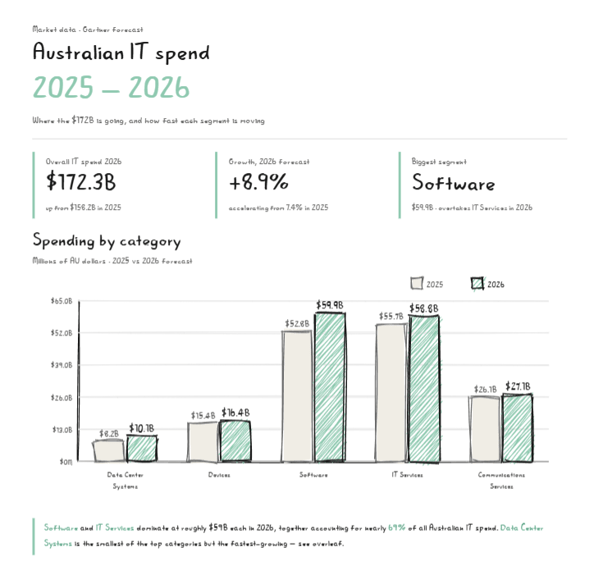
According to Gartner, IT spending in Australia is expected to exceed $172 billion in 2026, with a large percentage of it on software. Furthermore, research from Digital Silk suggests that companies use an average of 112 SaaS apps, but 73% of employees don’t use their assigned licenses.
2. Manual Work That Should’ve Been Automated Is Still Happening
There’s nothing more monotonous than inputting raw data into a spreadsheet. Or copy-pasting customer details from one app to another. Or sending the same follow-up email for the hundredth time this month.
If your team is still doing tasks that a workflow could handle in seconds, you're not just losing hours, you're losing money. And worse, you're losing the good people who didn't sign up to be human data-entry machines. Most of these processes can be automated with tools you're already paying for. They’re just not set up properly.
3. Tech Tools Multiply but Efficiency Stays the Same
One app for project management. Another for time tracking. A third for invoicing, a fourth for messaging, and somehow a fifth one your marketing person swears by. Sound familiar?
While the main issue might not be in how many apps you use, the problem is that none of them talk to each other. Your team ends up parkouring between tabs and software while adding more credentials to your company’s password manager (give your poor Bitwarden a break!). More technology ≠ higher efficiency.
.png?width=603&height=362&name=image%20(1).png)
4. “Turning It Off and On Again” Is a Temporary Fix to a Perpetual Problem
“Have you tried turning it off and on again?” Of course you have. It’s the first and millionth thing you did this morning. If you're rebooting the same machine, refreshing the same dashboard, or clearing the same cache every other day, that's not a fix—you’re simply slapping a band-aid on an open wound.
Recurring issues are almost always a symptom of something deeper: outdated infrastructure, mismatched systems, or software that was never meant to scale with you. Do you know how much time or money you are losing during your IT downtime?
.png?width=603&height=327&name=image%20(2).png)
5. Systems Are Held by Duct Tape and Only One Person Knows How It Works
Every growing business has that one person. The one who built the spreadsheet that runs payroll. The one who set up the integration that nobody's allowed to touch. The one who goes on annual leave and somehow the whole office descends into chaos. Let’s call him “Greg.”
Now what happens when Greg can’t come into work one day because he got hit by a bus? Systems fail. Efficiency decreases. The entire planet goes into apocalypse (or that’s what it feels like anyway). Storing all the vital information in one guy’s head is like having one fire extinguisher for the whole building, and Greg took it home for the weekend.
Proper tech setups are documented, scalable, and not reliant on Dave from accounts to keep the lights on.
The Bottom Line
If two or more of these sound a little too familiar, your business has officially outgrown its DIY tech setup. The good news? You don't need to rip everything out and start from scratch. You just need the right people to take a look under the hood, figure out what's working, what's broken, and what's costing you more than it should.
Start small. Get your technology audited. From there, we can help you build a tech stack that actually scales with your business, instead of holding it back.
Because the technology should be working for you, not the other way around.
Where Teams Usually Get Stuck
How do I know which tech to keep and which to replace?
You don't always need to guess. The goal isn't to nuke your entire setup, it's to figure out what's pulling its weight and what's quietly bleeding you dry. Start by listing every subscription you pay for, then ask two questions: who actually uses it, and what would break if we cancelled it tomorrow? You'll be surprised how many tools quietly fail both tests. If you'd rather skip the spreadsheet headache, our tech audit does the heavy lifting for you.
Isn't upgrading our business tech going to be expensive?
It can feel that way upfront, but the real question is what your current setup is already costing you. Between unused licenses, manual hours, recurring downtime, and the dreaded "we lost the file again" moments, most businesses are already paying a premium for tech that doesn't work. A proper upgrade usually pays for itself within months, not years. The expensive option is doing nothing.
What's the first thing I should do if I recognised my business in this article?
Book a tech audit. It's the cheapest, lowest-risk way to find out where your money and time are actually leaking. A solid audit will show you what's working, what's redundant, what's a security risk, and what's costing you more than it should. From there, you can make decisions based on facts, not vibes. You can book yours here and we'll take it from there.
Can't I just hire an in-house IT person instead?
You can, but for most growing businesses, it's not the most efficient move. One person can't cover cybersecurity, cloud infrastructure, software integrations, hardware support, and strategy all at once. And the average IT salary in Australia is well over $90,000 a year, before you factor in tools, training, and leave cover. A managed service provider gives you a whole team's worth of expertise for a fraction of the cost, and you don't have to worry about Greg getting hit by a bus (see point 5).

Comments